Trump Orders AI Data Centers to Return Energy Surplus to Local Grids
The new directive seeks to mitigate local opposition to data centers by requiring operators to share excess power generation with nearby residents.
By Samir Nasser ·
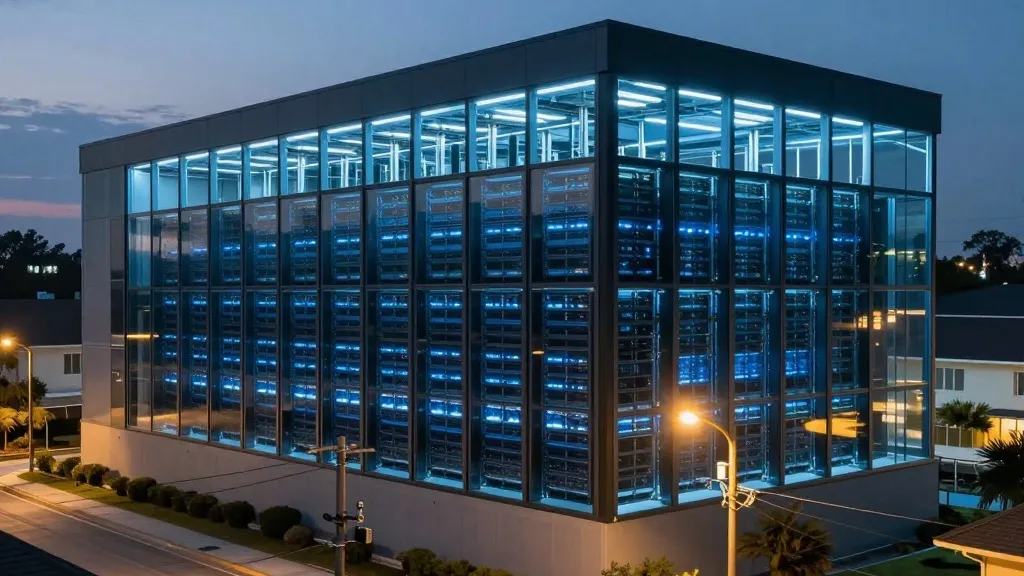
President Donald Trump has issued a directive requiring artificial intelligence data center operators and hyperscalers to return excess energy to local communities. The move, announced via Truth Social on Tuesday, aims to transform a source of local resentment into a financial benefit for residents. By mandating that these facilities sell or give back surplus electricity, the administration hopes to stabilize or even reduce local utility rates, thereby making the presence of massive data centers more acceptable to the neighborhoods housing them.
The announcement marks a strategic pivot for the administration, which has previously prioritized the speed of AI development over local environmental concerns. The core rationale is to address the growing friction between tech giants and the small communities that host their infrastructure. As the United States races to maintain a lead over China in the AI sector, the government is seeking ways to win back public favor by ensuring that the economic footprint of these facilities yields tangible rewards for the people living nearby.
Local opposition to AI data centers has intensified across the country in recent months. Residents frequently cite a host of grievances, including rising electricity bills, increased noise pollution, water shortages, and air quality issues. Deforestation and general ecological strain are also common complaints. The administration's new approach acknowledges these pain points by offering a direct economic offset, specifically targeting the cost of electricity, which is a primary concern for households in the vicinity of these power-hungry sites.
This requirement builds on a prior order that compelled data center builders to generate their own electricity. Under the new framework, the surplus power produced by these self-generated sources would be directed toward the local grid. This mechanism is intended to work in tandem with a recently passed law that requires data centers to cover the costs of necessary grid upgrades. By shifting these infrastructure costs away from local tax bases, the policy aims to ensure that the financial burden of expansion does not fall on the very communities it is meant to benefit.
In his post, Trump highlighted the potential for these financial arrangements to shift public opinion. He noted that data centers which were once highly unpopular in specific areas have become extremely popular once a financial deal was struck. The President urged industry leaders to “MAKE DEALS, and get them built!!!”, signaling a clear preference for accelerated construction timelines supported by community buy-in.
However, the practical implementation of this mandate remains to be seen. While the energy dividend addresses the immediate concern of utility costs, it does not resolve other significant challenges associated with data centers. Issues such as enormous water consumption, long-term ecological damage, and pollution remain major hurdles. For many communities, a lower electric bill may not be sufficient compensation for these broader environmental impacts, leaving the policy's long-term success uncertain.
The directive also raises questions about the timing of these financial benefits. Data centers are capital-intensive projects that often operate at a loss during their initial construction and ramp-up phases. Terminology such as “dividend” may imply a level of profitability that new builds have yet to achieve. Furthermore, the short-term power generation solutions often employed by these facilities involve gas-powered generators, which can be noisy and polluting. Critics argue that while the financial offset is a step forward, it does not fully address the quality-of-life concerns that have driven local resistance.
Ultimately, the administration is betting that economic incentives will outweigh environmental and logistical complaints. By tying the expansion of AI infrastructure to community benefits, the policy attempts to create a model where data centers are viewed as partners in local development rather than burdens. Whether this approach can successfully scale across the nation’s increasingly contested data center sites will depend on how effectively these energy-sharing agreements are negotiated and enforced in the coming months.
Source: Tom's Hardware